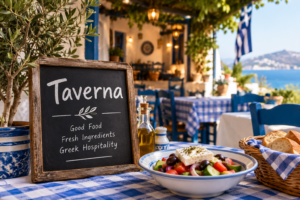
What Does ‘Taverna’ Mean in a Greek Restaurant Context?
Anyone who has spent an evening in Greece has heard the word before a menu even arrives. Taverna. It sounds simple enough, yet it carries centuries of history, a particular rhythm of eating, and an entire philosophy about what a meal is supposed to be. Understanding what a taverna really is changes how you experience Greek food, whether you are sitting in a small square in Crete or booking a table closer to home.
The Origins of the Word
The word taverna comes from the Latin taberna, meaning a shop, stall or inn. It entered Greek during the Roman period and gradually came to describe a place where ordinary people gathered to eat and drink together, rather than the grander dining rooms of the upper classes. Early Greek tavernas grew out of small grocery stores known as bakalika, where a few outdoor tables let customers enjoy a glass of wine with olives and cheese. Over time these humble setups evolved into full eating houses for working people, often called oinomageireia, combining the Greek words for wine and cooked food.
So a taverna was never designed to be formal. It was built by and for people who wanted a relaxed place to eat, drink and spend time with each other after a long day.
Taverna Versus Other Greek Restaurants
Not every Greek restaurant is a taverna, even though visitors often use the words interchangeably. Greeks themselves draw clear lines between different types of eating places.
An estiatorio is a more formal restaurant, typically with a fixed menu and individually plated dishes. A magirio serves the day’s cooked specials straight from large pots, usually at lunchtime, with little fuss and excellent home style food. An ouzeri centres around ouzo, tsipouro or wine, paired with small plates of meze.
A taverna sits comfortably in the middle of all this. It is informal, usually family run, focused on traditional home cooking, and built entirely around the idea of sharing a table for hours rather than rushing through courses. The atmosphere matters as much as the food.
Sharing Is the Whole Point
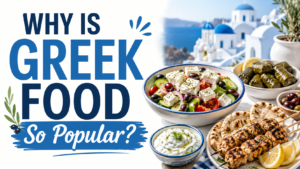
If there is one idea that defines a taverna more than any other, it is this: the food is meant to be shared. Dishes are placed in the centre of the table rather than served as individual plates. A horiatiki salad, made with ripe tomatoes, cucumber, olives and feta, is passed around rather than portioned out. Dips like tzatziki and melitzanosalata arrive early with fresh bread, followed by smaller meze dishes such as kolokithokeftedes or saganaki, and heavier mains like moussaka or slow cooked lamb for those who want them.
This is why a proper taverna meal rarely follows the strict starter, main, dessert structure that many diners expect elsewhere. Dishes arrive as they are ready, the table fills gradually, and everyone eats a little of everything.
Hospitality Without the Clock
A taverna is also defined by what does not happen. Nobody rushes you through the meal. Nobody clears your plate the moment you set your fork down. Conversation, wine and second helpings of bread are all part of the experience, and staying at the table long after the food is finished is completely normal.
Many tavernas also practise kerasma, a small unannounced gift from the kitchen such as a sweet, a shot of raki or a glass of something special, offered simply as a gesture of hospitality. It is not on the bill, and it is not expected to be. It is simply how a family run kitchen treats its guests.
Bringing the Taverna Tradition to Bournemouth
This is exactly the spirit behind Crete Island Restaurant. As a family run kitchen with more than twenty five years of culinary experience rooted in Cretan tradition, the aim has always been to recreate that same unhurried, generous atmosphere found in a genuine Greek taverna, right here in Bournemouth.
That means starting with shared plates like Tzatziki and Melitzanosalata, moving through a proper Greek Salad at the centre of the table, and letting the meal build naturally toward heartier dishes such as Moussaka or Kleftiko. Every dish is prepared using fresh, authentic ingredients, including extra virgin olive oil sourced from small Cretan farms.
Experience It for Yourself
Understanding what taverna means is one thing. Sitting down to it is another entirely. If you would like to experience genuine Greek hospitality, warm company and food made the way generations of Cretan families have made it, explore the full menu online or reserve your table at Crete Island Restaurant today. For more stories behind Greek food and culture, visit the blog for further reading.