At first glance, a Greek salad might look like just another bowl of chopped vegetables tossed with cheese. But once you taste an authentic one, you quickly realise it stands worlds apart from the standard “regular” salad found on most menus. From the ingredients and dressing to the very philosophy behind the dish, a proper Greek salad tells a story of sunlit Greek islands, generations of tradition, and simple ingredients treated with real respect.
What Counts as a “Regular” Salad?
A regular salad, sometimes called a garden salad or side salad, is usually built on a base of lettuce. Think iceberg, romaine, or mixed leaves, topped with tomato, cucumber, sweetcorn, grated carrot, croutons, and often a creamy dressing like ranch, Caesar, or a thick vinaigrette poured straight from a bottle. It is designed to be quick, filling, and easy to customise, which is why it appears next to burgers, sandwiches, and grilled meats on nearly every Western menu. The taste is familiar, comforting, and rarely surprising.
What Makes a Greek Salad Different?
The traditional Greek salad, known in Greece as Horiatiki (which literally means “village salad”), follows a completely different rulebook. For a start, it usually contains no lettuce at all. Instead, the focus is on a handful of quality ingredients allowed to shine on their own: ripe tomatoes cut into thick wedges, cucumber, green pepper, sliced red onion, Kalamata olives, and a generous slab of feta cheese placed on top rather than crumbled through the bowl. Every element is chosen for freshness, and every plate feels rustic rather than fussy.
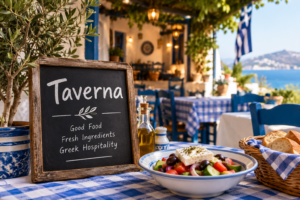
You can taste this classic version in the authentic Greek Salad at Crete Island, prepared just the way it is served in the tavernas of Crete.
The Ingredients Tell the Story
The clearest difference lies in what actually goes into the bowl.
A regular salad leans heavily on lettuce and uses many small toppings to build flavour. A Greek salad uses fewer components, but each one carries its own weight. The tomatoes are ripe and juicy, the olives are briny Kalamatas rather than tinned black ones, and the feta is a proper Greek block, salty and creamy at once. There are no croutons, no bacon bits, and no shredded cheese blend. What you get is honest food where you can identify every single ingredient on the plate, and where quality matters far more than quantity.
Dressings Set Them Apart
In a regular salad, the dressing often defines the flavour. Creamy sauces, sweetened vinaigrettes, and bottled blends do most of the work, sometimes masking the vegetables underneath.
A Greek salad takes the opposite approach. The dressing is nothing more than a good drizzle of extra virgin olive oil, a splash of red wine vinegar or lemon juice, and a generous sprinkle of dried oregano with a pinch of salt. This lets the tomatoes, olives, and feta stay in the spotlight, and it is why authentic Greek olive oil, the kind we use at Crete Island, makes such a noticeable difference.
A Difference in Purpose and Culture
A regular salad is usually a side dish or a light meal, chosen mainly to add greens to a plate. A Greek salad, on the other hand, is a shared centrepiece. In Greece, families and friends gather around a table with a big bowl of Horiatiki, tearing crusty bread to soak up the last of the oil and feta at the bottom. It is not just food; it is a moment of connection, one that fits perfectly into a proper Greek meal alongside grilled meats, seafood, or slow cooked classics like moussaka.
Taste the Real Thing at Crete Island
If you have only ever tried the Western version, the difference is worth experiencing for yourself. Our chefs bring true Cretan flavours to Bournemouth, using authentic feta, quality Kalamata olives, and olive oil from small Cretan farms.
Explore our full menu or book a table and discover how a simple bowl of vegetables can taste like a holiday.